
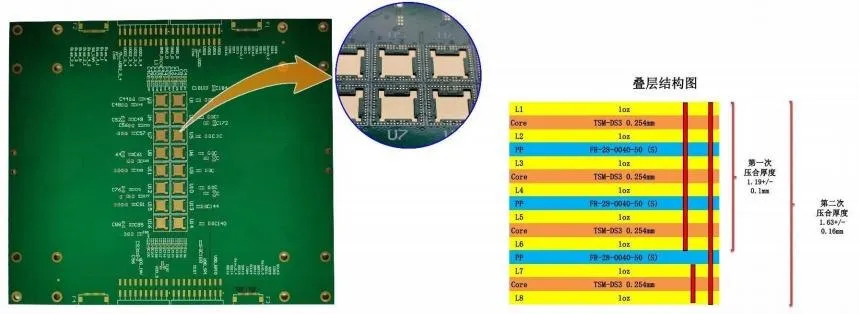
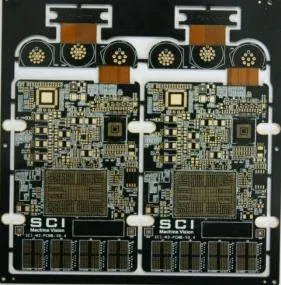
77 GHz radar high-frequency board
- Layers
- 18
- Materials
- TSM-DS3 + FR28 prepreg + S1000-2M, hybrid lamination
- Finish
- Immersion gold (ENIG)
- Special process
- Blind and buried vias, controlled impedance and 5 back-drill groups
Set operating frequency, laminate requirements, critical dimensions and verification scope before selecting the board construction.
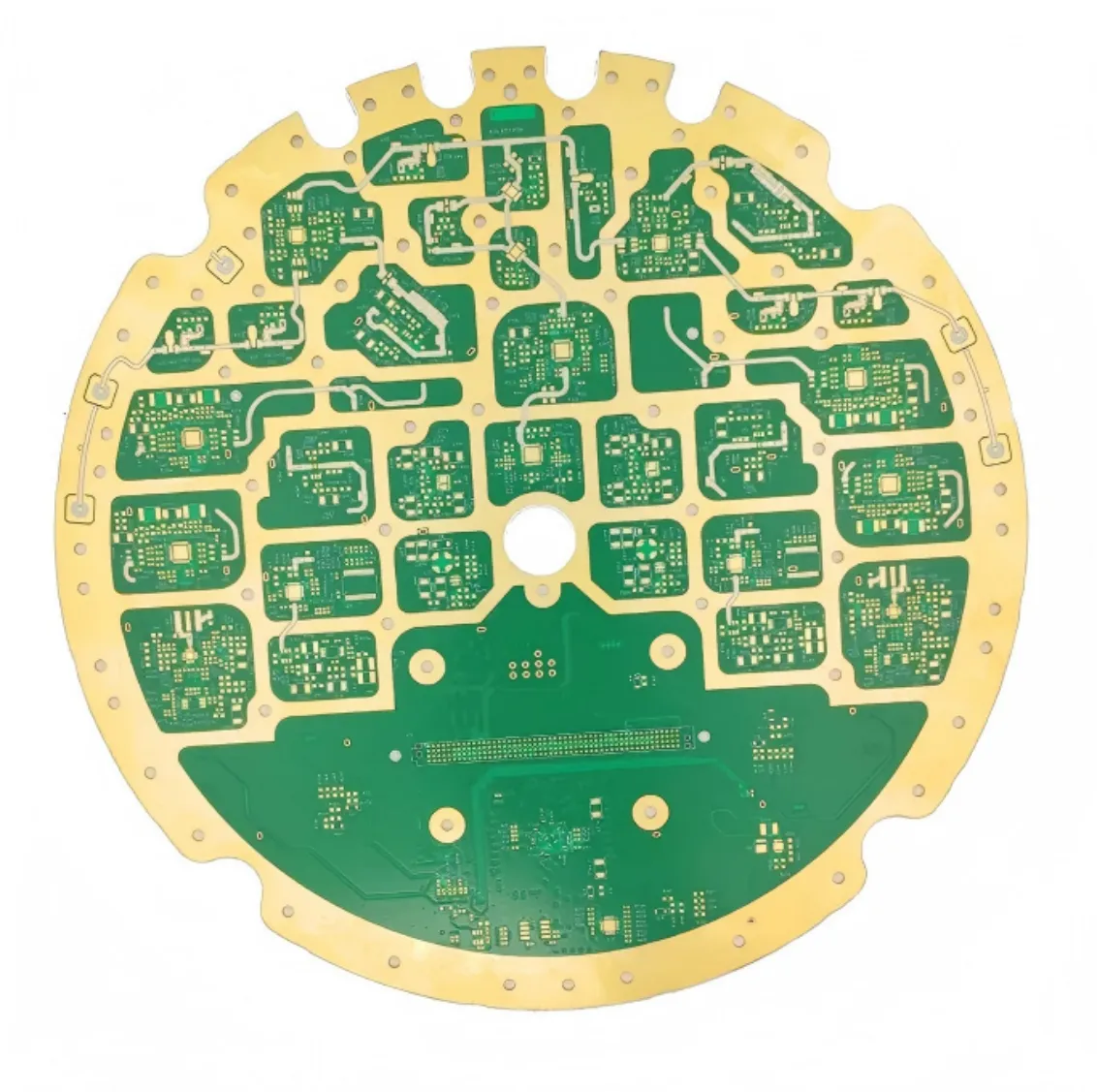
The 77 GHz multilayer sample combines hybrid lamination and five back-drill groups. The eight-layer millimeter-wave antenna sample uses RT5880, soft gold and laser profiling.
Send frequency, material grade, critical dimensions and impedance targets. Mark the traces, holes or outline features that need inspection records.
Typical requirements from the ShinePCB application capability sheet. Each project is reviewed against its own drawing and specification.
| End product / typical modules | Applicable PCB types | Key processes | Material direction | Engineering focus |
|---|---|---|---|---|
| Industrial / security / automotive / weather radar — RF antenna, front end, signal processing | High-frequency, hybrid high-frequency, HDI | Hybrid lamination; impedance; fine lines; back drilling; layer registration | Rogers, Isola, PTFE | Dk/Df consistency; copper roughness; phase consistency; warpage |
| Satellite communication terminals / ground stations — phased array, RF front end, baseband | High-frequency, hybrid high-frequency, high-speed multilayer | Hybrid lamination; impedance; back drilling; high layer count | mmWave / microwave; low-loss | Low loss; phase consistency; dimensional stability |
| Aviation communication / radar / RF modules | High-frequency, hybrid, high-speed multilayer, rigid-flex | Hybrid lamination; fine lines; impedance; back drilling; edge metallization | Microwave; low-loss; high-reliability FR-4 | RF loss; temperature cycling; vibration; material traceability |
Application descriptions show typical board requirements. They are not customer references, and end-product standards remain the responsibility of the product owner. Aerospace projects are supported through AS9100 certified partner factories; automotive radar is built under IATF 16949.
Compare stack-up, hole geometry and inspection requirements with your design.
It depends on your frequency and loss targets. See high-frequency PCB.
Hybrid stack-ups are reviewed per project.